
As part of several high-profile initiatives to commemorate Hermann Park’s 100th birthday in 2014, Hermann Park Conservancy launched Art in the Park. Art in the Park was a series of contemporary art installations displayed over the Park’s 445 acres throughout 2014 and beyond.
After seeing the popularity of Art in the Park and the need for art to be part of programming initiatives, the Conservancy determined that raising a large endowment fund to support Art in the Park was the way to continue the highly acclaimed program. With that, the Conservancy launched the Fund for Public Art in the spring of 2017 with the goal of funding the Art in the Park program.
Art in the Park endeavors to mirror its site, a public park, by presenting open, accessible artworks that engage visitors on multiple levels. Guided by the unexpected delight of new discoveries and the child-like joy they can engender, the artworks will be carefully selected and expertly sited to enhance the Hermann Park experience.
Kicking off the revival of Art in the Park, the Conservancy commissioned two installations to coincide with the opening of the Commons. The first is Scattering Surface, by Brooklyn-based artist Alyson Shotz, installed in April 2024 and on display in a natural area adjacent to McGovern Lake and the Japanese Garden, across the pedestrian island from the Commons. Joining Scattering Surface is an installation called Canopy, by Houstonian Anthony Suber, which made its debut in June 2024. Suber’s piece is on view in the Commons, located on Bob and Elsa’s Memorial Art Grove, adjacent to the Japanese Garden’s west entrance. The new installations join Trenton Doyle Hancock’s Destination Mound Town, installed in 2014, which is on display in the Hermann Park Railroad tunnel and can be seen as you ride the rails.
To make a gift to support the Fund for Public Art in Hermann Park, please click here.
The Real Elephant Collective

The Real Elephant Collective
The Great Elephant Migration, 2025
Lantana camara
In 2025, Hermann Park welcomed The Great Elephant Migration—a spectacular public art exhibition of 100 life-sized elephant sculptures, brought to Houston as part of Hermann Park Conservancy’s Art in the Park initiative. The herd, handwoven by indigenous artisans from India’s Nilgiri Hills, captivated thousands of visitors and carried a message of coexistence, conservation, and ecological resilience.
The sculptures are made from Lantana camara, an invasive plant species that has overrun India’s forests, threatening native flora and fauna. By transforming this ecological threat into art, the artisans reclaim their landscapes while honoring the wild elephants with whom they share them. Each sculpture represents a real elephant—known by name and character—crafted with remarkable detail and deep cultural knowledge.
The Great Elephant Migration traveled across the United States—with stops in Newport, RI; the Meatpacking District in New York City; Miami; Houston; Jackson Hole, WY; Browning, MT; and Los Angeles—sharing indigenous wisdom and supporting over 20 conservation organizations globally.
Moved by the elephants’ message and magic, local donors came forward to help preserve part of the herd in Hermann Park. Thanks to their generosity, four sculptures now remain on permanent display: Lotus (Matriarch), Nanu (Matriarch), Banyan (Adolescent), and Iinii’ohsokoyi (Calf). Together, they form the Hermann Park herd—a lasting tribute to the power of art, community, and conservation.
You can find the herd in the Commons, located at the Cece and Mack Fowler Art Grove, which is along the trail parallel to Fannin Street leading to the Commons. Please find a map here for the location.
This work is the creation of The Real Elephant Collective, a group of over 200 indigenous artisans from the Nilgiri Biosphere Reserve in southern India. Using Lantana camara, a woody invasive plant, the community has sculpted each elephant they live alongside—capturing not only anatomy, but personality and spirit. The process is both an act of ecological restoration and cultural storytelling, rooted in deep knowledge of the forest and its inhabitants.
To ensure the preservation of the sculptures, we ask that visitors do not touch, climb, or pull on them.
Anthony Suber

Anthony Suber
Canopy, 2024
Steel, Aluminum, Dichroic Glass and Copper
As part of the Conservancy’s Art in the Park program, alongside the opening of the Commons, Texas native Anthony Suber was commissioned to create a piece for the Park. Installed in June 2024, Canopy is a metal and glass structure in the form of an enlarged, abstract monstera plant that encourages the viewer to engage and sit underneath the canopy it creates. The design references “deconstructed sacred geometry,” using the three-sided form of a triangle, connecting to the ideas of enlightenment and spiritual harmony.
Canopy symbolizes the physical and spiritual, while also representing a multigenerational conversation in how burgeoning generations sprout from the foundation of their ancestors in a continuous cycle. Concurrently, it represents an arc from childhood to the eventual return to the earth below in a physical sense.
Each leaf doubles as an enlarged geometric mask that from the outside utilizes strong diagonals to form intersecting triangles and a mix of reinterpreted sacred geometric forms. The inside of each leaf form, made from color-shifting dichroic glass, reflects the surrounding environment with the intention of creating a small visual sanctuary of light, but it most importantly reflects the viewer. The reflective interior of the structure contrasts the cast shadows around Canopy depending on the time of day. The concrete foundation of Canopy is the shape of the predominant geometric “leaf masks” of the structure, and it is a homage to the ancestors and the base of their collective memory.
You can find Canopy in the Commons, located on Bob and Elsa’s Memorial Art Grove which is adjacent to the Japanese Garden’s west entrance. Please find a map here for the location.
Suber is an interdisciplinary artist working and living in Southeast Texas. He received a BFA from the University of Houston and completed his MFA at Houston Christian University. Throughout his career, Suber has exhibited work and produced multi-tiered activations both nationally and abroad. Suber is a professor of art with the Kathrine G. McGovern College at University of Houston’s School of Art and an artist-in-residence with Project Row Houses in Houston’s historic Third Ward community.
Canopy is generously supported by Ellen Benninghoven and Michael Schafer, in loving memory of Ellen’s parents, Bob and Elsa Kaim, and their lifelong dedication to the arts and social justice. Their legacy lives on with their children.
Alyson Shotz

Alyson Shotz
Scattering Surface, 2024
Stainless Steel and Polished Stainless Steel
Alyson Shotz is an American sculptor living in Brooklyn, New York. Shotz is known for large-scale sculptures that subvert their own physicality in order to explore the phenomenological experience of space, gravity, light and matter.
Hermann Park Conservancy commissioned Shotz to create a new sculpture for Hermann Park to kick off a re-energized Art in the Park program alongside the opening of the Commons. Installed in April 2024, the new 16-foot high sculpture: Scattering Surface is named for a phenomenon of light itself. It refers to cosmological theory about the first light of the universe that is visible to us.
The sculpture is composed of thousands of welded stainless steel circles, which reflect light and scatter the visible surroundings into tiny pieces, shifting and moving across the sculpture like an analog screen. The play between the reflections and the spaces between reflections draws attention to the idea of solidity itself as the sculpture creates an optical continuum where negative and positive space continually intertwine.
In Scattering Surface, Shotz is looking at large-scale steel sculpture in a different way. Instead of creating a solid and heavy welded piece, she has created something light – air flows through it and the steel almost seems translucent.
You can find Scattering Surface in the quiet area between the Japanese Garden, McGovern Lake, and the pedestrian island and bridge. Please find a map here for the location. Scattering Surface is a temporary exhibition on display through 2026.
Shotz’s work is included in numerous public collections, such as the Solomon R. Guggenheim Museum, New York, The Guggenheim Bilbao, The Hirshhorn Museum and Sculpture Garden, Washington, DC, The San Francisco Museum of Modern Art, Crystal Bridges Museum of American Art, The Museum of Fine Arts, Houston, The DeCordova Sculpture Park and Museum, and Storm King Art Center among others.
Courtesy of the artist and Derek Eller Gallery, New York.
Trenton Doyle Hancock

Destination Mound Town
Trenton Doyle Hancock (American, 1974)
Destination Mound Town, 2014
Vinyl, Mixed Media
Dimensions variable
Houston-based artist Trenton Doyle Hancock has transformed the interior walls of Hermann Park Railroad’s train tunnel into a fantastical landscape populated with creatures both real and imagined. Destination Mound Town is a contribution to Hancock’s ongoing narrative in his artwork of the Mounds, a group of mythical half-animal, half-plant characters. Train passengers will be transported into a day in the life of the Mounds, beginning the journey as they arise in morning and exiting the tunnel as they settle in for the night. To view the installation, hop on the Hermann Park Railroad at Kinder Station, or at any of the remote stops, and keep your eyes open as you enter the tunnel. For hours and information on the Hermann Park Railroad, visit the Train information page.
The recipient of numerous awards, Hancock lives and works in Houston, where he was a 2002 Core Artist in Residence at the Glassell School of Art of the Museum of Fine Arts, Houston. His artwork can be found in the permanent collections of the Brooklyn Museum; Museum of Fine Arts, Houston; Dallas Museum of Art; Museo di Arte Moderna e Contemporanea in Trento, Italy; San Francisco Museum of Modern Art and the Whitney Museum of American Art in New York. Hancock’s first retrospective exhibition was on view at the Contemporary Arts Museum, Houston beginning in April 2014.
Please note: there is no safe pedestrian access into the train tunnel. The work is only visible by train.
PREVIOUS EXHIBITS
Sharon Engelstein

Dillidiidae
Sharon Engelstein (Canadian, born 1965)
Dillidiidae, 2014
Foam, polymer concrete shell
Dimensions variable
Photo: Megan Badger Photography / Courtesy Weingarten Art Group
A former Museum of Fine Arts, Houston Core Fellow and a resident of Houston for many years, Sharon Engelstein is known for her organic, bubbly sculptural forms. In Hermann Park, a grand Mamadillidiida figure loomed protectively over her wandering brood of smaller Dillidiidae. Though not immediately recognizable, the Dillidiidae were identical quadruplets. Curiously familiar, these tumbling forms invited interactivity, creating a game of delight and discovery.
The Dillidiidae was located on the grassy berm near the Buddy Carruth Playground for All Children and the intersection of Fannin and Cambridge Streets.
Dillidiidae was on display until April 2022.
Orly Genger

Boys Cry Too
Orly Genger (American, born 1979)
Boys Cry Too, 2009
Painted climbing rope
Dimensions variable
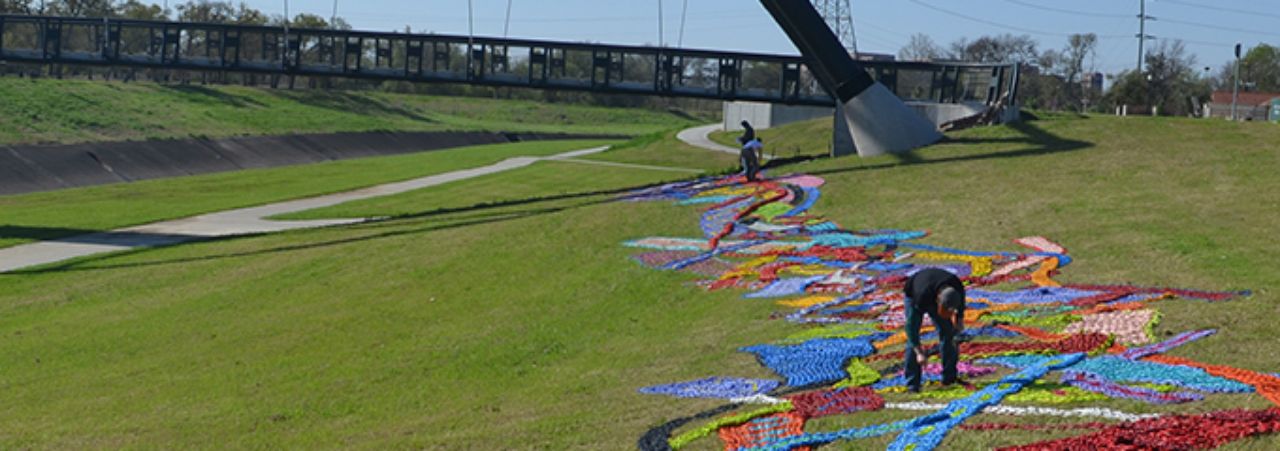
New York-based Orly Genger re-worked a previous piece for the Park’s landscaping alongside Brays Bayou near the Bill Coats Bridge. Genger garnered attention for her large-scale constructions of brightly painted, knotted nautical rope. Spanning the genres of craft and fine art, Genger mines the intimate, domestic, and traditionally feminine practice of knitting to create sprawling, monumental installations. With the help of assistants, Genger looms, crochets, weaves, and knots heavy twine over the course of many months to create a single work.
The installation in Hermann Park, made of knotted climbing rope, sat on the banks of Brays Bayou on the Bayou Parkland side of Hermann Park between South MacGregor Way and Almeda. Measuring 225 feet long by 17 feet wide and painted in a wide range of colors including Eggnog, Springtime Bloom, Limeade, and many more, Boys Cry Too seemed to pop off of the Park’s terrain.
Genger’s work has been exhibited at Madison Square Park and deCordova Sculpture Park and Museum in New York, and has been included in numerous group and solo exhibitions.
Boys Cry Too was on view through March 24, 2015.
Patrick Dougherty

Boogie Woogie
Patrick Dougherty (American, born 1945)
Boogie Woogie, 2014
Saplings
Dimensions variable
Patrick Dougherty, a North Carolina-based artist, is known for creating whirling quasi-architectural sculptures from locally-harvested saplings. In January 2014, Dougherty and a team of Hermann Park Conservancy volunteers constructed the site-specific installation Boogie Woogie in Hermann Park. Installation took place over a period of three weeks using 6 tons of harvested saplings — mostly invasive Chinese tallow — gathered from Generation Park, a master-planned enterprise development in northeast Houston. Volunteers worked under the close direction of the artist and his assistant throughout the project. The project required over 150 volunteers and more than 1,000 volunteer hours to complete. This piece was inspired by the nearby Hermann Park Japanese Garden and could be explored through the passageways of the “glyph maze” and the “walls” that made up the piece. Dougherty has completed over 230 works in his career with installations throughout the United States and around the world.
Boogie Woogie was on display through September 2015.